Tax day is rapidly approaching, which means real estate investors across the state are currently buried in spreadsheets, receipts, and P&L statements. There is no better time of the year to take a step back and look at the macro-level performance of your real estate portfolio.
As you review your numbers from last year, you might notice that some properties put a lot of money in your pocket every month, while others barely broke even (but their overall value skyrocketed). This brings us to the most fundamental strategic decision every real estate investor must make.
When acquiring or holding property, are you playing the short game or the long game?
The debate of cash flow vs appreciation in Minnesota is a hot topic for 2026. The economic landscape has shifted dramatically over the last few years. High interest rates have compressed monthly margins, making pure cash flow harder to find. Meanwhile, low housing inventory continues to drive up property values, making appreciation an incredibly powerful wealth-building tool.
Today, we are going to break down these two financial pillars, explore how they behave differently in the Twin Cities compared to Greater Minnesota, and help you build a recession-resistant investment strategy for the future.
The Mid-April Audit: Reviewing Your Real Estate ROI
Before you buy your next property or decide to sell an existing one, you need a clearly defined investment goal. Real estate is not a one-size-fits-all asset class. An investor nearing retirement needs a very different portfolio than a young professional buying their first duplex.
To determine your strategy, you must first understand the two primary ways that real estate puts money in your pocket.
The Great Real Estate Debate: Cash Flow vs Appreciation in Minnesota
Let us define the terms to ensure we are operating from the same baseline.
Defining Cash Flow (The "Now" Money)
Cash flow is the net income your property generates each month after all expenses are paid. This includes the mortgage, property taxes, insurance, property management fees, and a reserve set aside for maintenance and vacancy.
The Goal: To generate immediate, spendable income.
The Investor Profile: Retirees looking to replace their W-2 income, or investors seeking financial freedom in the near term. If your goal is to quit your day job next year, you need cash-flowing properties to pay your grocery bills.
Defining Appreciation (The "Later" Wealth)
Appreciation is the increase in your property's overall market value over time. If you buy a single-family home for $300,000 and sell it ten years later for $450,000, you have gained $150,000 in appreciation.
The Goal: To build massive, long-term net worth and leverage equity for future investments.
The Investor Profile: High-earning professionals who already have a strong primary income. They do not need the extra $200 a month in cash flow today. They want a multimillion-dollar net worth a decade from now.
The Twin Cities Metro: The Appreciation Engine
Real estate behavior is hyper-local. If you are analyzing cash flow vs appreciation in Minnesota, you have to look at the map.
The Twin Cities Metro area (and its immediate surrounding suburbs) is widely considered an appreciation market. The population is stable, major corporate headquarters provide high-paying jobs, and land for new development is becoming scarce.
High Entry Costs and Modest Margins
Because the Twin Cities is a highly desirable place to live, the cost to acquire a property is steep. Buying a duplex in a prime Metro neighborhood will require a significant down payment and a hefty monthly mortgage.
When you factor in 2026 interest rates and high property taxes, it is very difficult to achieve massive cash flow in the Metro right out of the gate. In many cases, an investor might only net $100 to $200 a month. Some investors are perfectly content just breaking even.
Why? Because the tenant is paying down the mortgage while the property value steadily climbs.
The Power of Forced Appreciation in the Suburbs
In the first and second-ring suburbs of the Twin Cities, investors have a unique opportunity for "forced appreciation." This involves buying an outdated, Class C property in a great school district and renovating it. By updating the kitchens and bathrooms, you force the value of the home up immediately. This increases your overall equity and allows you to command top-tier Metro rent prices.
Greater Minnesota: The Cash Flow Goldmine
If your primary goal is to generate monthly income, you need to cast your net wider. Greater Minnesota is where the cash flow strategy truly shines.
Lower Acquisition Costs
In rural counties and mid-sized hubs like St. Cloud, Mankato, or Rochester, the barrier to entry is significantly lower. You can often purchase a fourplex in Greater Minnesota for the exact same price as a single-family home in the Twin Cities.
Because your mortgage payments are lower, the spread between your expenses and your collected rent is much wider. A well-managed property in these areas can yield hundreds (or even thousands) of dollars in positive cash flow every single month.
The Workforce Housing Yield
Greater Minnesota is currently experiencing a severe shortage of affordable workforce housing. This scarcity means vacancy rates are incredibly low. When you provide clean, safe, and reliable housing in these communities, you are rewarded with sticky, long-term tenants and consistent, reliable cash flow.
However, you must temper your expectations for appreciation. A property in a rural town will not double in value overnight. The growth curve is much flatter compared to the Metro.
Interest Rates and the 2026 Reality Check
We cannot talk about investment strategy without addressing the economic climate. In 2026, interest rates remain a critical factor in the cash flow equation.
When borrowing costs are high, your monthly mortgage payment eats directly into your cash flow. Many properties that would have cash-flowed beautifully in 2021 are now operating at a loss simply because of the interest rate on the loan.
This environment has forced many investors to pivot. Instead of seeking pure cash flow on new acquisitions, they are buying in high-appreciation Metro areas, accepting a break-even monthly return, and banking on future equity growth and the ability to refinance when rates eventually drop.
The Hybrid Strategy: Can You Have Both in Minnesota?
The ultimate holy grail of real estate investing is finding a property that offers both strong cash flow and rapid appreciation. While rare, it is possible in the Minnesota market if you know where to look.
Value-Add Investing in Tier-Two Markets
The best way to achieve the hybrid strategy is to look at tier-two cities that are currently undergoing revitalization. These are towns sitting just outside the main Metro ring that are experiencing sudden job growth or new infrastructure projects. Buying a multi-family property in an emerging neighborhood allows you to secure a lower purchase price (aiding cash flow) while riding the wave of neighborhood gentrification (driving appreciation).
The Portfolio Balancing Act
The most successful real estate investors do not choose just one strategy. They balance their portfolios.
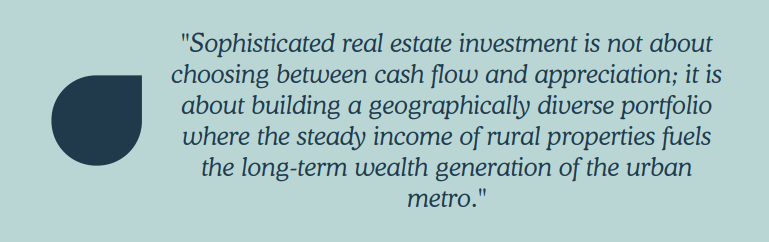
A sophisticated investor might own three properties in Greater Minnesota that generate $3,000 a month in pure cash flow. They then use that cash flow to subsidize the purchase of a luxury single-family rental in the Twin Cities. The Metro property might barely break even each month, but it will appreciate by hundreds of thousands of dollars over the next decade.
By diversifying geographically, you protect yourself against market fluctuations while achieving both short-term income and long-term wealth.
How Professional Management Protects Both Metrics
Whether you are chasing monthly checks or decade-long equity, poor property management will destroy your returns.
If you are a cash-flow investor, extended vacancy is your worst enemy. A property sitting empty for two months will wipe out your entire annual cash flow profit. You need a management team that pre-leases aggressively and turns units over in days, not weeks.
If you are an appreciation investor, deferred maintenance is your worst enemy. If you ignore a leaky roof or allow a tenant to destroy the hardwood floors, your property value will plummet. You need a management team that conducts rigorous routine inspections and handles preventative maintenance proactively.
Optimize Your Investment Strategy with Angie Toomey Real Estate Group
You cannot build a strategic portfolio if you are constantly stuck in the operational weeds. If you spend your time unclogging drains and chasing rent checks, you will never have the mental bandwidth to analyze market trends and source your next great deal.
At Angie Toomey Real Estate Group, we act as your strategic partners. We provide the meticulous, high-level property management required to extract maximum value from your assets. We protect your cash flow through rigorous tenant screening and minimal vacancy. We protect your appreciation through proactive asset preservation.
Let us handle the daily operations so you can focus on building your empire.
Is Your Portfolio Performing at Its Peak?
Do not guess when it comes to your real estate ROI. Whether you need to increase the monthly yield on a rural multi-family property or protect the long-term value of a Twin Cities luxury rental, Angie Toomey Real Estate Group has the expertise you need.
Our Asset Management Advantage:
Data-Driven Rent Maximization: We ensure you are collecting top-of-market rent to boost your cash flow.
Proactive Property Preservation: We coordinate top-tier maintenance to protect and enhance your property's value.
Strategic Portfolio Review: We help you align your properties with your ultimate financial goals.
👉 Call or text us today to schedule a free portfolio performance review and rental analysis!